The Pikillaqta Ruins or Flea Town Near Cusco
James Bustamante is Native to New York but born to Peruvian parents. He has been traveling throughout Latin America since early 2003 and finally made his home in Peru. James has made his way by eating and traveling through almost every country in Central and South America.
Last Updated on May 21, 2021 by James Bustamante
The Pikillaqta ruins are part of an archaeological complex that houses structures that are over 2,000 years old. This location also goes by the name of the “flea town”, however scholars are unsure of its original name. The village of Pikillaqta has structures that predate the Incan empire and go all the way back to the older “Wari” culture.
Table of Contents
What Does Pikillaqta Mean?
Pikillaqta or sometimes written as Pikillacta or Piquillacta is written in the Quechua language and is a two-part, “Piki” meaning “flea” and “llaqta” meaning “place”. So the name translates to flea place, however, “llaqta” was used to describe a town, village, a community, a nation, or even country in this native tongue. Quechua or different versions of it was widely spoken in the region before the Incan empire made it their official language.
Scholars are not sure what this village or what the ruins were originally called by the Wari culture. The Inca renamed this complex, however, the name used in their empire is also unknown. There are a few archaeologists that suggest the Inca used the term “Muyuna” meaning “bend” to describe the town but cannot confirm the veracity.
Where is Pikillaqcta Located?
Pikillaqta is located in the province of Quispicanchis in the eastern section of Cusco near hilly terrain on the Lucre Basin at over 10,662.73 feet above sea level(3,250 meters above sea level). It is curiously not located near any rivers (only small lakes), this is rare for villages or other constructions of that time and of this magnitude.
How Do I Get to Pikillaqta?
To get to Pikillaqta you have to travel 12.42 miles (20 km) outside of the city of Cusco going east until you reach the Quispicanchi province on the route that heads towards Puno and Arequipa. It’s a relatively short drive by car, you can even take a bus to the village of Pikillaqta.
The Purpose of The Pikillaqta Ruins
The first people to inhabit this area were the Wari culture which predated the Incan empire. At the height of the reign of the Incas, this area was conquered and formed part of the Tahuantinsuyo empire (Incan Empire).
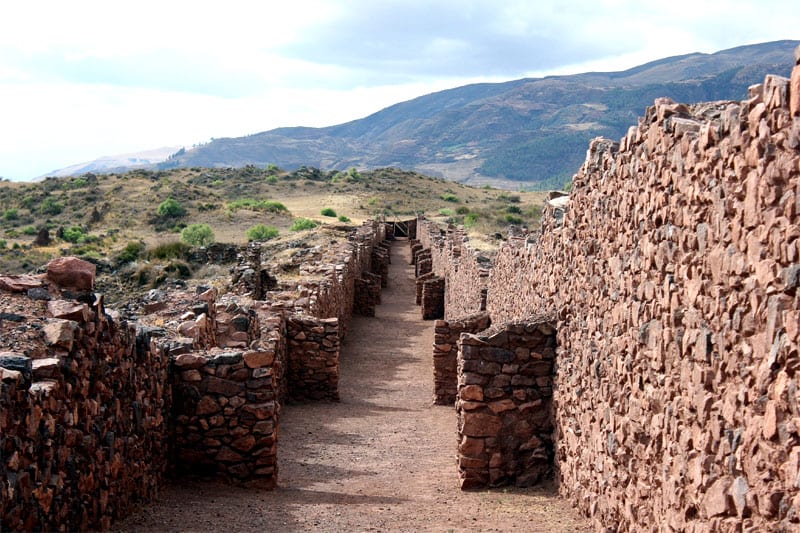
The Pikillaqta ruins can be described as an unfinished village, the Wari left the complex before being able to culminate the work on the buildings. There are over 600 pieces of construction in Pikillaqta, this includes wide-open fields scattered in the village as well as “Tambos” which were constructions meant for storage.
The patio in the middle of the site was most likely used for religious practice as well as administrative services and rituals. It is believed by scholars that the ruins of Pikillaqta were used as a place of gathering and celebrations. The ruling Wari would have festivities where the major families would get together for food and drink.
The plaza was of obvious importance in the Pikillaqta ruins however there are other locations that might have been more important for ceremonial purposes. There are remains of niched halls that appear to have been very important when it came to celebrations, a total of 18 halls were found by archaeologists.
Abandonment of Pikillaqta
Pikillaqta town was inhabited from 550 AD to around 1100 AD when the Wari culture mysteriously left the location. Archaeologists are not sure what drove the Wari to eventually leave Pikillaqta however it is theorized that the Wari were trying to expand their empire elsewhere and planned to return. The truth is that the complex was abandoned without the construction is completely finished.
Apparently, the abandonment of Pikillaqta was followed by a massive fire. This further adds to the mystery since the blaze happened sometime after the Wari had already left the complex.
After the Wari left Pikillaqta, there seem to have been people that were not part of the Wari, that decided to try to destroy the abandoned ruins by setting fire to them. There are beams that have been carbonized which suggest the fire might have been deliberate.
Scholars believe the attempted expansion of the Wari is what seems to have driven the end of their empire.
The Pikillaqta Climate
The climate at Pikillaqta is similar to the one found in Cusco and the surrounding areas. An average of 70 degrees Fahrenheit (19 degrees centigrade) during the daytime. The rainy season will start in mid-November and continue all the way until March of the following year.
You can visit the “flea town” at any point during the year however if you are looking for the absolute best weather, try coming between April and October.
Agriculture At Pikillaqta
In a similar fashion as the Incas, the Wari were dependent on maize since it was one of their most important crops. This crop was so important to the Wari people that their pottery has maize painted on it along with deities.
Water was a very important commodity to have for the Wari and the nearest available supply was the Wakarpay lagoon almost a mile away. In order to grow maize as well as other crops, the Pikillaqta used a system of aqueducts, canals, reservoirs, and terraces. The local people had a hydraulic network that would permit irrigation. The water for the network would primarily come from the region’s rainfall.
What to Pack for The Pikillaqta Ruins?
The Pikillaqta ruins are in the highland region so it is important to basically pack as if you were going on the Machu Picchu hike, Cusco city tour, or Sacred Valley tour.
- Bring Sunglasses and Sunblock
- Cap or hat for protection from the sun (see a pattern?)
- Chapstick or lip balm is particularly important during the wet season.
- Insect repellent (particularly important during the wet season)
- Rain poncho
- Comfortable hiking shoes (boots not necessary)
- Hiking style pants, anything that is comfortable and dries quickly.
- T-shirts, light jackets, sweaters, or jumpers.
- Several pairs of socks, particularly necessary during the rainy season.
- Snacks like trail mix, we burn a lot of calories hiking in high elevation.
Tips For Visiting Pikillaqta
Just like if you were visiting any other area near the Peruvian highlands, make sure to have comfortable footwear to hike throughout the day. If you are traveling during the dry season remember to wear a hat to help protect you from the sun. Since we are so high in elevation the sun can really burn even when it is not particularly hot.
If you plan on traveling during the rainy season, then make sure to always have a rain poncho handy. It can be sunny with apparently great weather during the rainy seasons, but that can change in an instant so proper gear is a must.
Conclusion
The Pikillaqta ruins are an interesting set of old constructions to visit, one of the biggest attractions of the location will be the fact that it predates the Incan empire. In order to program a visit to Pikillaqta or “the Inca flea town” contact one of our travel advisers today for an itinerary for a Peru tour package.